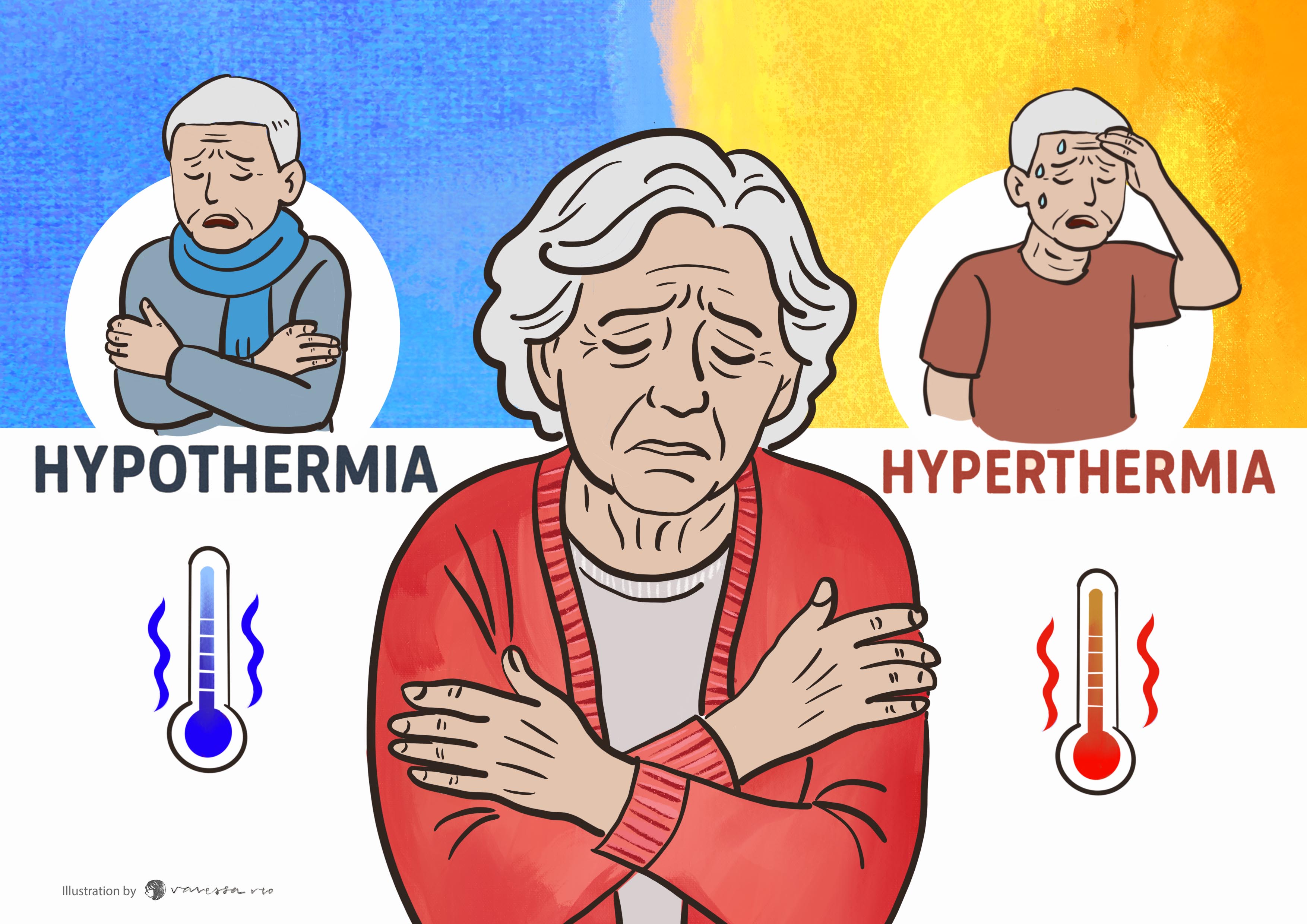
 Older adults are at a higher risk of both hypothermia and hyperthermia.
Many clinical reports show that people over 60 are the most at risk, often experiencing more serious heat-related health problems than other age cohort when exposed to high temperatures and also have a reduced ability to maintain core body temperature during cold exposure compared to younger individuals (Van Someren, E. J. W., 2007; Balmain B. N. et al., 2018; Smolander J., 2002).
-
Normal body temperature ranges from 36.5 to 37.5 °C
- Hypothermia is defined as a drop in body temperature below 35°C. Hypothermia develops when the body loses heat faster than it can generate or absorb, disrupting homeostasis and impairing normal bodily functions. Although it is most commonly triggered by prolonged exposure to cold and insufficient heat production, various external factors may heighten the risk. If left untreated, hypothermia can be life-threatening (Duong, H., & Patel, G., 2024).
- Hyperthermia is defined as the condition in which the internal core temperature exceeds the normal range that cannot relieved by sweating. Hyperthermia is a result of the loss of equilibrium in the heat balance equation such that heat is produced or stored in the body at a rate in excess of heat lost through radiation, convection, or evaporation (Sanko, J., 2007).
Regulating Body Temperature As We Age
- Body temperature regulation involves on nearly all body systems and they decline with age and also age-related changes in the skin and metabolic systems are unavoidable as we age.
- Our ability to warm up the body is slower (or vasoconstrictor response) when peripheral temperature drops as we get older. Therefore, we have difficulty to recognize when the core body temperature is low such as less likely to notice that we are cold (Cavanaugh J. C. & Blanchard-Fields F., 2019).
- Also, our body has difficulty to cope with high heat because the body produce less sweat as we age. This is because sweat production gradually decreases with age, starting from the lower limbs to the forehead (Blatteis, 2012; Liao & Jan, 2016 as cited in Cavanaugh J. C. & Blanchard-Fields F., 2019)
Some preventive measures
 hypothermia
- Stay indoor or in a warm place : Avoid unsafe exposure or too long exposure to cold outdoors (example: heavy wind, cold days or damp days)
- Wear warm and loose layers of clothing : gloves/mittens, hat, scarf, warm blankets, socks
- Safety : Get someone to check on the elderly during cold weather
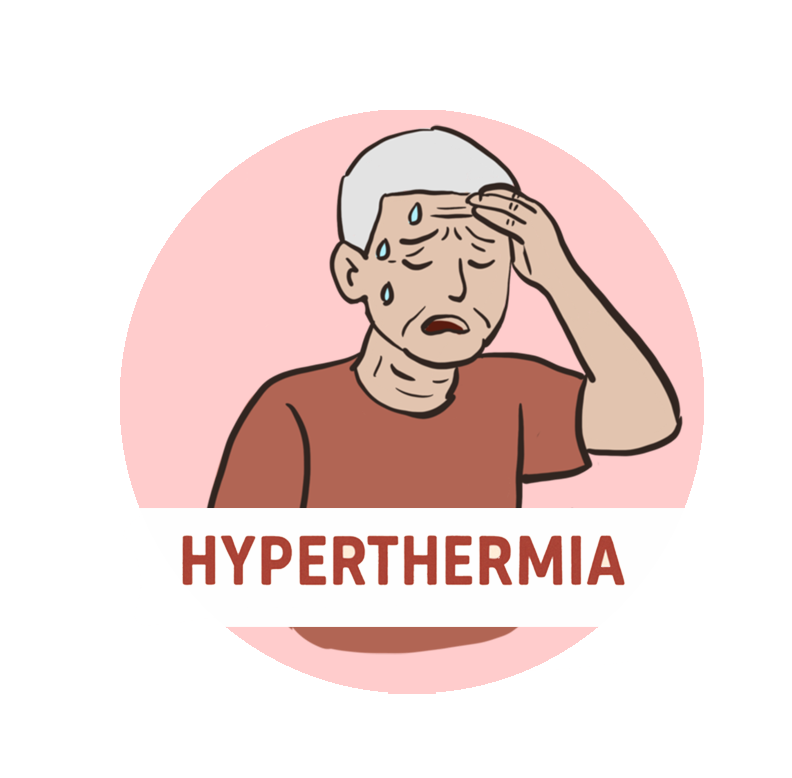 hyperthermia
- Drink plenty of water
- Wear lightweight, light color and loose fittings of clothing
- Safety : Keep your place as cool as possible, go to air-conditioned shelters, avoid outdoor activities
References:
Balmain, B. N., Sabapathy, S., Louis, M., & Morris, N. R. (2018). Aging and Thermoregulatory Control: The Clinical Implications of Exercising under Heat Stress in Older Individuals. BioMed research international, 2018, 8306154. https://doi.org/10.1155/2018/8306154
Cavanaugh J. C. & Blanchard-Fields F. (2019). Adult Development and Aging. 8th Edition. Cengage Learning, Inc.
Van Someren, E. J. W. (2007). Thermoregulation and aging. American Journal of Physiology–Regulatory, Integrative and Comparative Physiology, 292(1), R99–R102. https://doi.org/10.1152/ajpregu.00557.2006
Sanko, J. (2007). Thermoregulation: Considerations for aging people. In R. J. Webster (Ed.), Geriatric rehabilitation manual (2nd ed., pp. 53–60). Elsevier. https://doi.org/10.1016/B978-0-443-10233-2.50017-1
Duong, H., & Patel, G. (2024). Hypothermia. In StatPearls [Internet]. StatPearls Publishing. Retrieved [28 August 2025] https://www.ncbi.nlm.nih.gov/books/NBK545239/
Smolander J. (2002). Effect of cold exposure on older humans. International journal of sports medicine, 23(2), 86–92. https://doi.org/10.1055/s-2002-20137
National Institute on Aging. (n.d.). Cold Weather Safety for Older Adults. National Institute on Aging. Retrieved [29 August 2025] https://www.nia.nih.gov/health/safety/cold-weather-safety-older-adults
National Institute on Aging. (n.d.). Hot Weather Safety for Older Adults. National Institute on Aging. Retrieved [29 August 2025] https://www.nia.nih.gov/health/safety/hot-weather-safety-older-adults

Similar Post
What is healthy aging?
Sep 03, 2025
Is stress affected our health?
Aug 26, 2025
What are the changes in our skin when we age?
Aug 02, 2025